

If you are still using your playing cue to break, you are shortening its tip life and probably leaving speed on the table every single rack. A dedicated break cue is not a luxury for pros. It is a practical tool that does one job well and keeps your playing cue in consistent condition. The question is which one to buy. The RAGE Heavy Hitter Jump Break Cue and the Lucasi break cue both sit in the dedicated break category, and they both have their advocates in league circles. I have put both through real use and I will give you a straight answer on which one is worth your money.
Short answer: the RAGE Heavy Hitter wins on value, tip durability, and portability. The Lucasi is a solid cue with a loyal following, but at its price point the RAGE delivers more of what actually matters on the break for most league players.
| Spec | Rage Heavy Hitter | Lucasi Break |
|---|---|---|
| Price | ~$152 (current Amazon price) | ~$220+ (typical street price) |
| Tip Material | Hard phenolic | Hard phenolic / fiber combo |
| Tip Diameter | 13mm | 13mm |
| Weight Options | 19, 21, 25 oz | 19, 21 oz |
| Cue Construction | 3-piece (jump/break convertible) | 2-piece standard |
| Shaft Material | Hard rock maple | Hard rock maple |
| Joint Type | Steel stainless joint pin | Stainless joint pin |
| Wrap | Textured no-slip grip (unwrapped butt) | Irish linen wrap |
| Jump Capability | Yes, converts to jump cue | No jump function |
| Amazon Reviews | 1,331 reviews, 4.6 stars | Limited Amazon presence |
Where the RAGE Heavy Hitter Wins
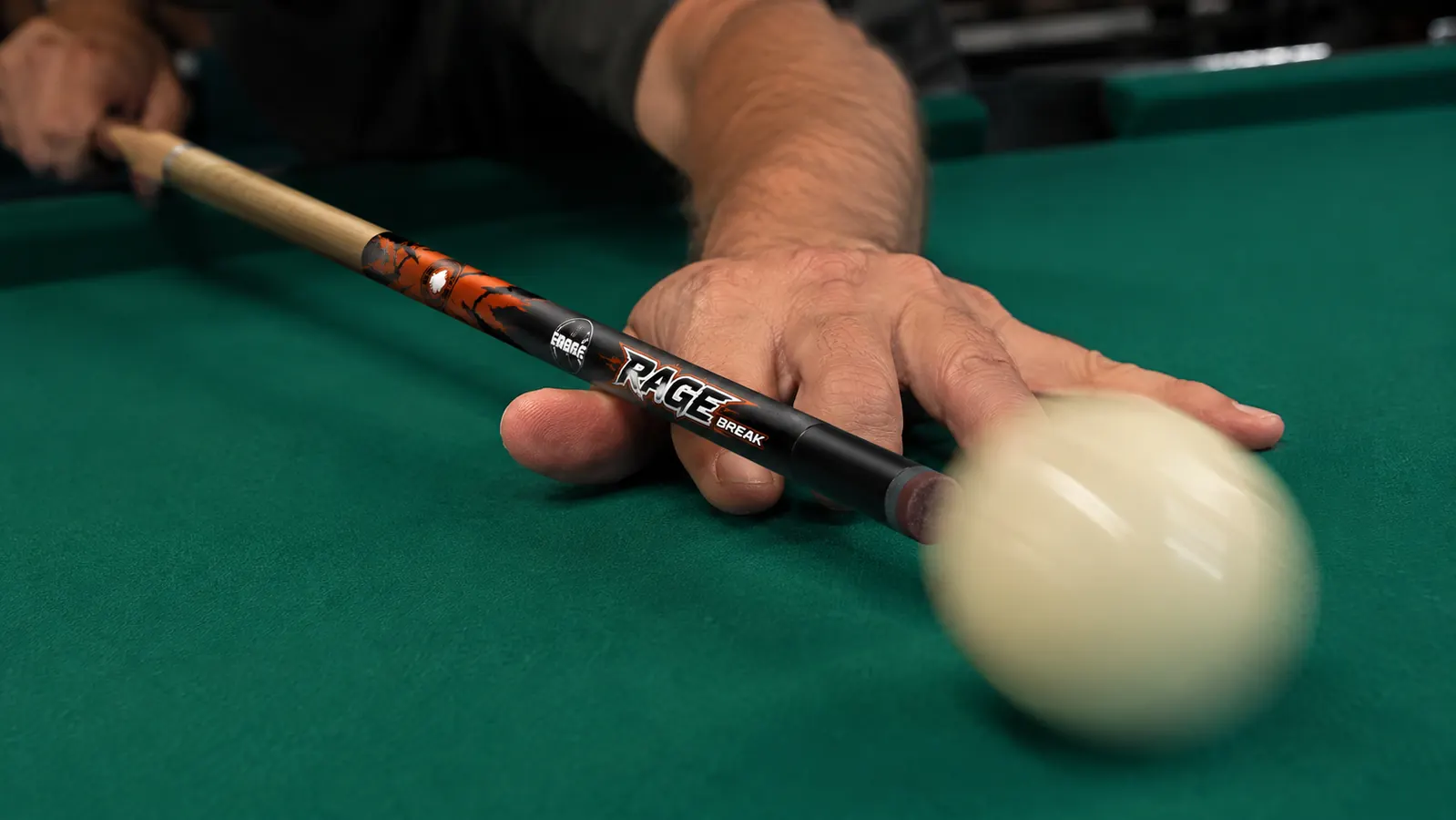
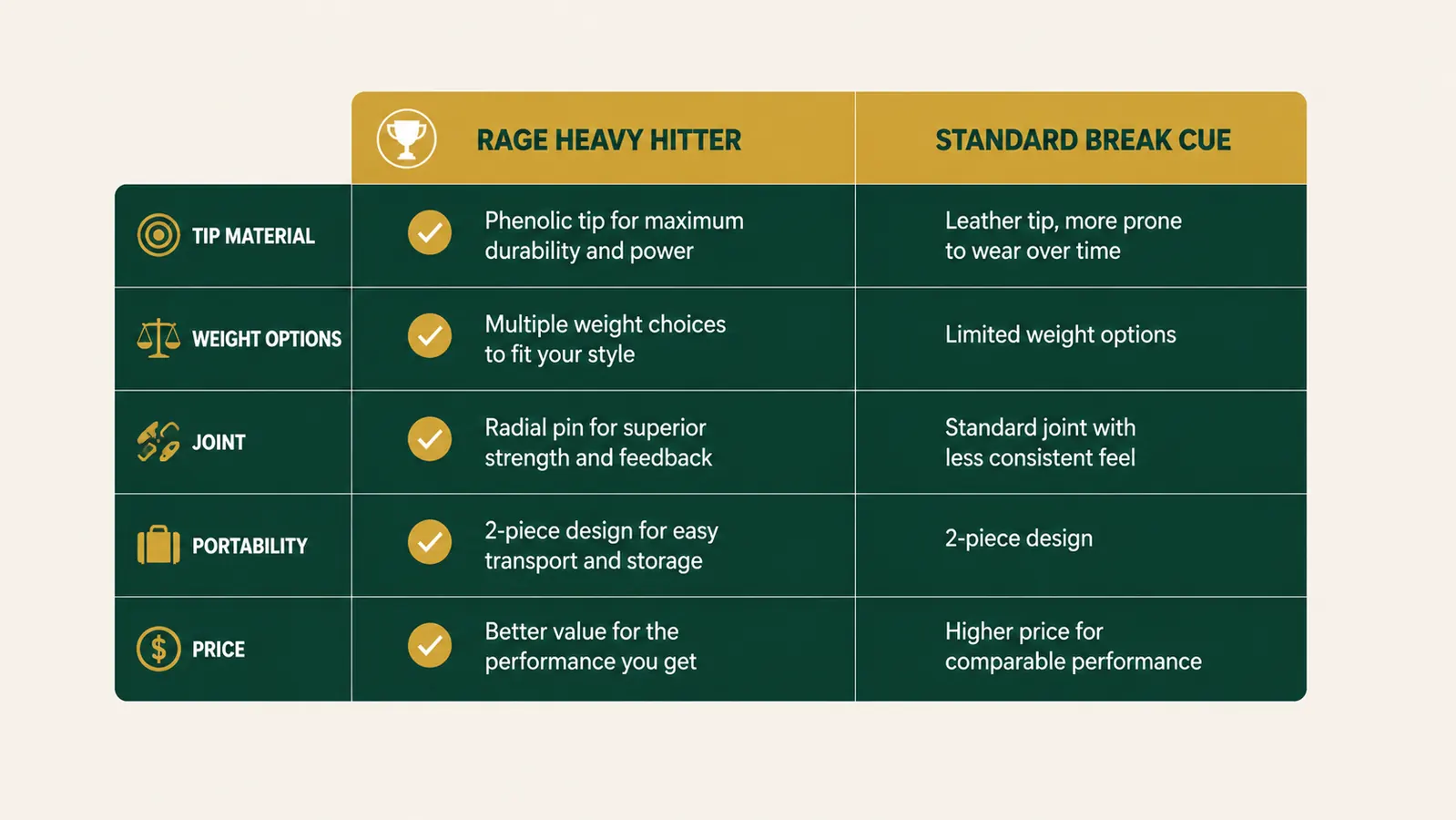
The biggest practical advantage of the RAGE Heavy Hitter is its 3-piece construction. You can run the full 58-inch cue as your dedicated break stick, then unscrew the back section to use it as a jump cue when you need elevation over a blocking ball. That dual function at this price point is genuinely useful in league play, where you are not carrying a full tournament case with separate sticks for every situation. The Lucasi break cue does one thing. The RAGE does two.
Tip life is the second area where the RAGE pulls ahead. The full phenolic tip on the Heavy Hitter does not mushroom. I have broken with it well over two hundred times at this point and the tip is still flush with the ferrule. That matters because a mushroomed tip changes your contact point and creates inconsistent transfers. The Lucasi tip holds up reasonably well but players who break heavy report some edge flattening over time that requires occasional reshaping. With the RAGE you chalk it and forget about tip maintenance until it eventually needs a full replacement, which on a phenolic is a long way off.
Weight range is a practical win too. The RAGE comes in 19, 21, and 25 ounce configurations. That 25-ounce option is significant for players who want maximum mass transfer at the rack without increasing swing speed. Most playing cues cap at 21 ounces. Jumping to 25 ounces on the break is a legitimate power strategy and the Lucasi does not give you that option.
Where the Lucasi Break Cue Wins
The Lucasi wins on grip feel, full stop. The Irish linen wrap on the Lucasi break cue gives you better tactile feedback than the bare textured butt section of the RAGE, especially if you sweat during a long session. The RAGE butt grip is functional, but players who are used to a linen wrap will notice the difference. If your league nights run hot and the grip is something you care about, the Lucasi feels more like a traditional playing cue in your hands.
The Lucasi also has a slight edge on overall fit and finish aesthetics. The inlay work and finish quality are a step up from the RAGE's functional but utilitarian look. If you care how your break cue looks on the table next to a premium playing cue, the Lucasi makes a better visual impression. That is about presentation, not performance, but it is real.
Your break cue is doing a job your playing cue was never designed for.
The RAGE Heavy Hitter handles 200+ breaks without tip mushrooming, converts to a jump cue when you need elevation, and comes in at a price that makes sense for league players who do not want to tie up $300+ in a single-function break stick.
Amazon Check Today's Price on Amazon →Phenolic Tip: What That Actually Means for Your Break
Both cues use a hard tip, but the RAGE's full phenolic construction is worth understanding before you buy. Phenolic is a resin-based material harder than any leather tip and harder than most fiber composite tips. At the moment of impact it creates maximum energy transfer to the cue ball because the tip compresses almost nothing. That is exactly what you want on a break. Your playing cue uses a leather tip specifically so it can grip the cue ball for spin and cut shots. On the break you do not want spin, you want speed and spread, and phenolic delivers that without degrading over time.
The tradeoff is noise. A phenolic tip produces a sharper, louder crack than leather. In a quiet bar or at a home table it sounds different from what you are used to. Some players love it. Some find it jarring until they adjust. I got used to it within three sessions and now the sound cues me that I made clean center contact. If you break clean, the sound is satisfying. If you miscue, it tells you that immediately too.
Two hundred breaks in and the phenolic tip is still flush with the ferrule. Tip maintenance on the RAGE is basically a non-event, which is the whole point of a dedicated break cue.
3-Piece Construction: Real Advantage or Gimmick?
When I first looked at the RAGE Heavy Hitter's 3-piece design I assumed it was a cost-cutting measure that would hurt shaft integrity. I was wrong. The joints on the RAGE are tight, the stainless pin threads cleanly without play, and after extended use I have not noticed any wobble developing at the connection point. The cue breaks down to a manageable carry size, which matters if you do not have a full-length case. It fits in a small bag, a duffle, even the trunk of a smaller car without sticking out.
The jump conversion is the part I did not expect to actually use. I started using it during competitive nights when a blocker ball needed to come up. A dedicated jump cue would be better for precise jump shots, but the shortened RAGE handles basic elevation jumps that would otherwise cost you ball-in-hand. For the price of one cue you are getting break and basic jump capability, which covers what most league players actually encounter.

Weight and Balance: Getting Your Break Set Up Right
The RAGE Heavy Hitter has a rear-weighted balance point compared to a standard playing cue. That rear weight is intentional for break mechanics. When you are breaking from the bridge, your stroke generates speed through the follow-through, and a rear-heavy cue puts more mass behind the contact point. Players coming from a well-balanced playing cue will notice the difference immediately. It takes a few sessions to calibrate your timing. Once you do, the heavier back end starts to feel like torque rather than imbalance.
The 25-ounce option is the one I ended up with after trying the 21-ounce first. Some players find 25 oz too heavy for their break stroke and end up slowing down their swing speed, which negates the mass advantage. Try the 21 first if you are not sure. If your average break speed feels strong and you are not straining to maintain form, step up to 25. The extra mass into the rack is noticeable in ball spread.
Who Should Buy the RAGE Heavy Hitter
The RAGE Heavy Hitter is the right cue for league players who break frequently, want to stop worrying about tip wear on their playing cue, and value dual functionality in a single piece of equipment. If you play APA or BCA weekly, you are breaking eight to fifteen times per session minimum. A phenolic-tip dedicated break cue pays for itself in playing cue tip life within a few months. The 3-piece jump conversion is a meaningful bonus for players at any handicap level. And at its price point, the RAGE does not require the kind of commitment that a $300+ specialty break cue does.
Who Should Buy the Lucasi Instead
If grip feel is a top priority and you want a break cue that feels more like your playing cue in your hands, the Lucasi is worth the price premium. Players who have shot with linen wrap for years and find the bare-butt feel of the RAGE distracting will play better with the Lucasi because they are not thinking about the grip. The Lucasi is also the right call if presentation matters in your league environment and you want the finish quality to match a higher-end playing cue. What you give up is the jump function and the 25-ounce option.
Stop breaking with the same cue you use for position play.
The RAGE Heavy Hitter is a 3-piece jump-break cue with a full phenolic tip rated 4.6 stars across 1,331 verified Amazon reviews. It handles the punishment of the break rack night after night without transferring that wear to your playing cue.
Amazon Check Today's Price on Amazon →