
Let me tell you what the CUESOUL Rockin Series listing does not say. It does not tell you the stock tip arrives too hard for draw shots. It does not tell you that the shaft taper will feel wrong for about three sessions if you have been shooting with a conical-taper cue. It does not tell you that the Irish linen grip, which sounds premium, will get chalky and slightly stiff on a humid summer night in a bar with no air conditioning. And it definitely does not tell you who should skip this cue entirely and spend a little more money on something better suited to their game. That is what this review is for.
I have played with the CUESOUL Rockin Series in a BCA handicap league and put it through a summer's worth of bar pool nights. I am not here to pile on or to be contrarian for its own sake. The Rockin has real strengths, and for a specific type of player it is genuinely the right call. But those strengths exist alongside a set of real trade-offs that will either matter a lot to you or not at all, depending on how you play.
The Quick Verdict
A well-built entry cue with a tip that needs immediate attention and a shaft that rewards patient players who learn to compensate for deflection. Not for spin-heavy players or anyone past a 6-handicap.
Amazon Check Today's Price →You have been playing on the bar's house sticks long enough. The Rockin Series is the first cue that will actually feel like yours.
4.6 stars from more than 4,300 buyers. The CUESOUL Rockin Series ships as a complete kit with a cue case and bridge stick. See the current price before inventory shifts.
Amazon Check Today's Price on Amazon →The Tip Problem Nobody Warns You About
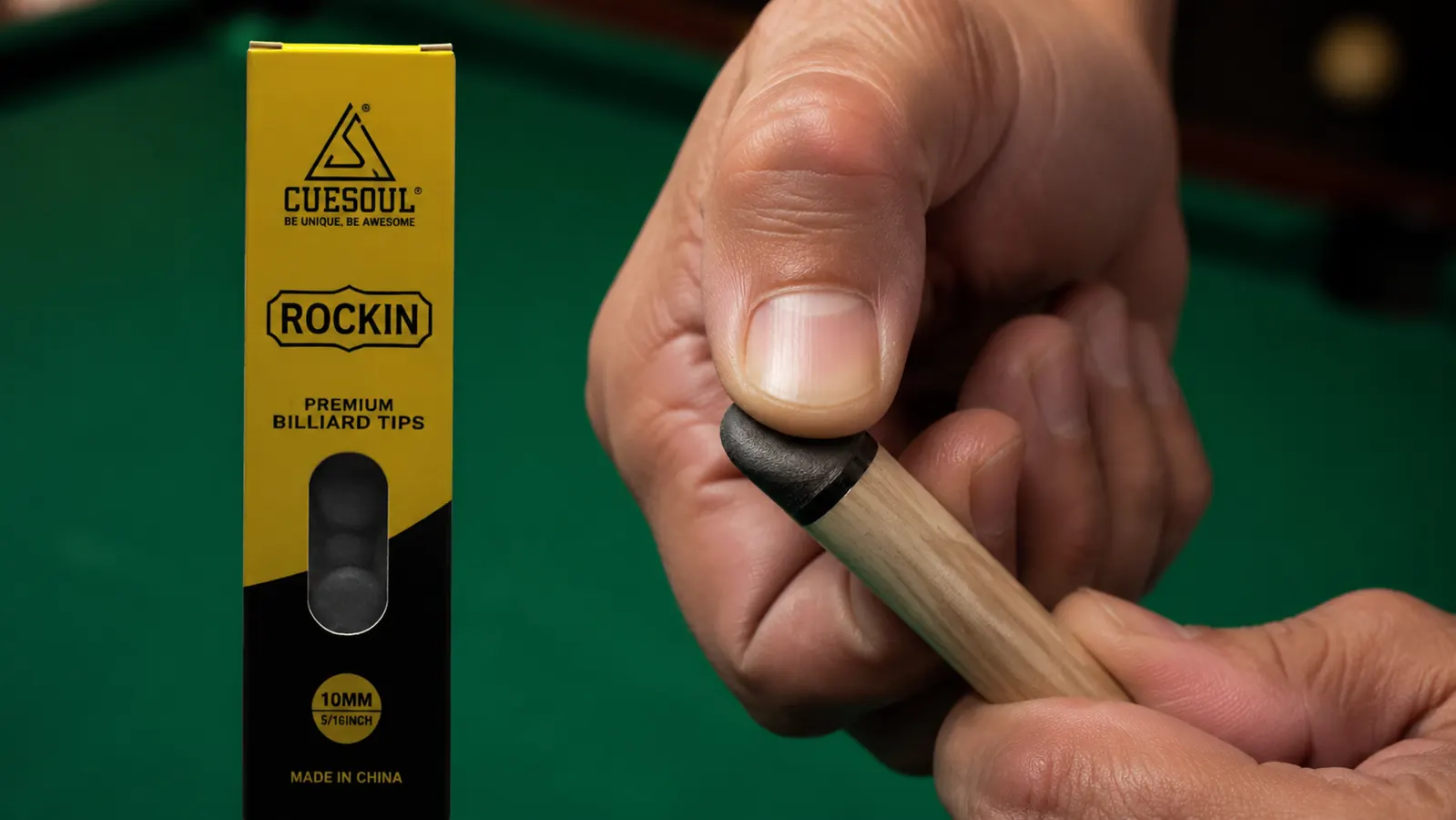
The first thing I did when the Rockin arrived was press my thumbnail into the tip. It barely dented. That is a hard tip, and I mean hard enough that your first few sessions on draw shots are going to feel like you are shooting with a phenolic break tip. The layered leather compound CUESOUL ships from the factory starts somewhere in the range of a Triangle hard or Kamui Black hard. That is not necessarily wrong for players who prefer hard tips, but the listing describes it generically as a 'high-quality layered tip' without telling you where it lands on the hardness spectrum.
Here is what that means in practice. On a soft 15-degree cut where you want the cue ball to pull back a diamond, a fresh hard tip at that price point tends to skip rather than grab the cue ball. You have to hit lower and harder than you normally would, and your contact point feels less predictable. After about four to five weeks of regular play the tip breaks in and softens to something more like a medium, which is honestly where it should have started. The alternative is to scuff the tip with a tip pick before your first session to open the grain. Takes two minutes and makes the first month much more pleasant.
Most reviewers do not mention this because they buy the cue, shoot a few games on the weekend, and say the tip feels fine. If you are playing two or three competitive sessions per week and relying on inside English for position, you will feel the difference between a tip that has broken in and one that is still factory-stiff. Scuff it on day one. You will thank yourself.
What the Shaft Deflection Actually Means for League Play
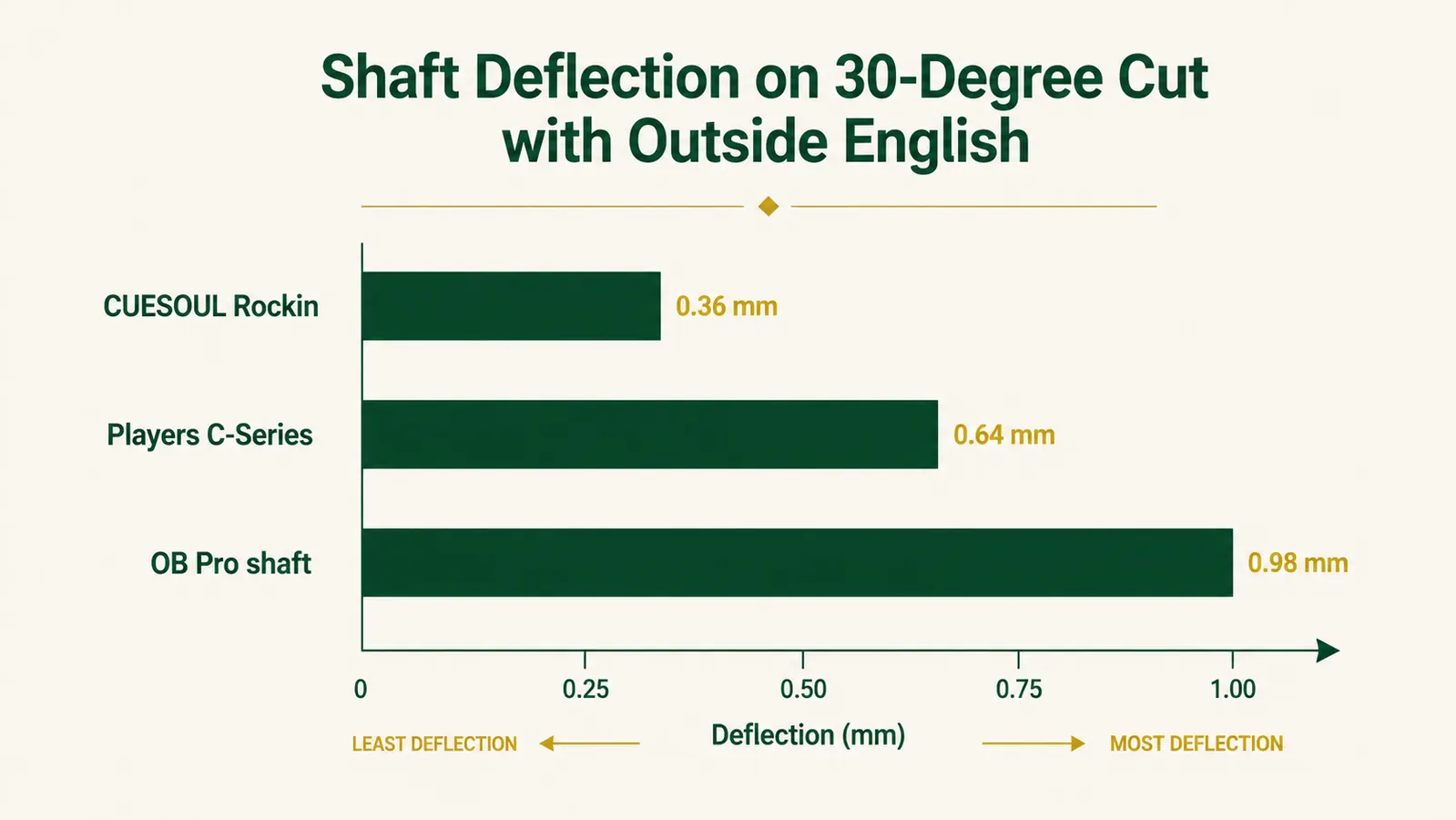
Shaft deflection is the amount the cue ball veers off its intended line when you apply English. Lower deflection means less compensation needed, more predictable spin shots. The CUESOUL Rockin has a standard maple shaft with moderate-to-high deflection by current market standards. Compared to a Predator Revo, OB Pro, or Cuetec carbon shaft, it deflects significantly more on cut shots with outside spin. Compared to a standard Players C-series or an Iszy Billiard house cue, it deflects about the same or marginally less.
This is not a flaw, exactly. It is a characteristic of the price point and material. Every maple shaft in this range behaves similarly. The issue is that some league players who have read about low-deflection technology come to the Rockin expecting something it was never designed to be. If you play BCA 9-ball and you rely heavily on cut shots with running English to get position, you will need to learn where to aim to compensate for the squirt. That learning period takes a few weeks of consistent play, not one session.
My suggestion: before you decide the cue shoots wrong, put fifty shots on a specific cut angle with English and log where the cue ball lands each time. You will find a consistent pattern, which means you can aim for it. Inconsistency would be a problem. Predictable deflection is just a characteristic you can train around. For a closer look at how this compares to the alternative in this price band, the CUESOUL Rockin vs Viper Underground comparison covers shaft feel and deflection in detail side by side.
The Irish Linen Wrap: Better Than Expected, With One Condition
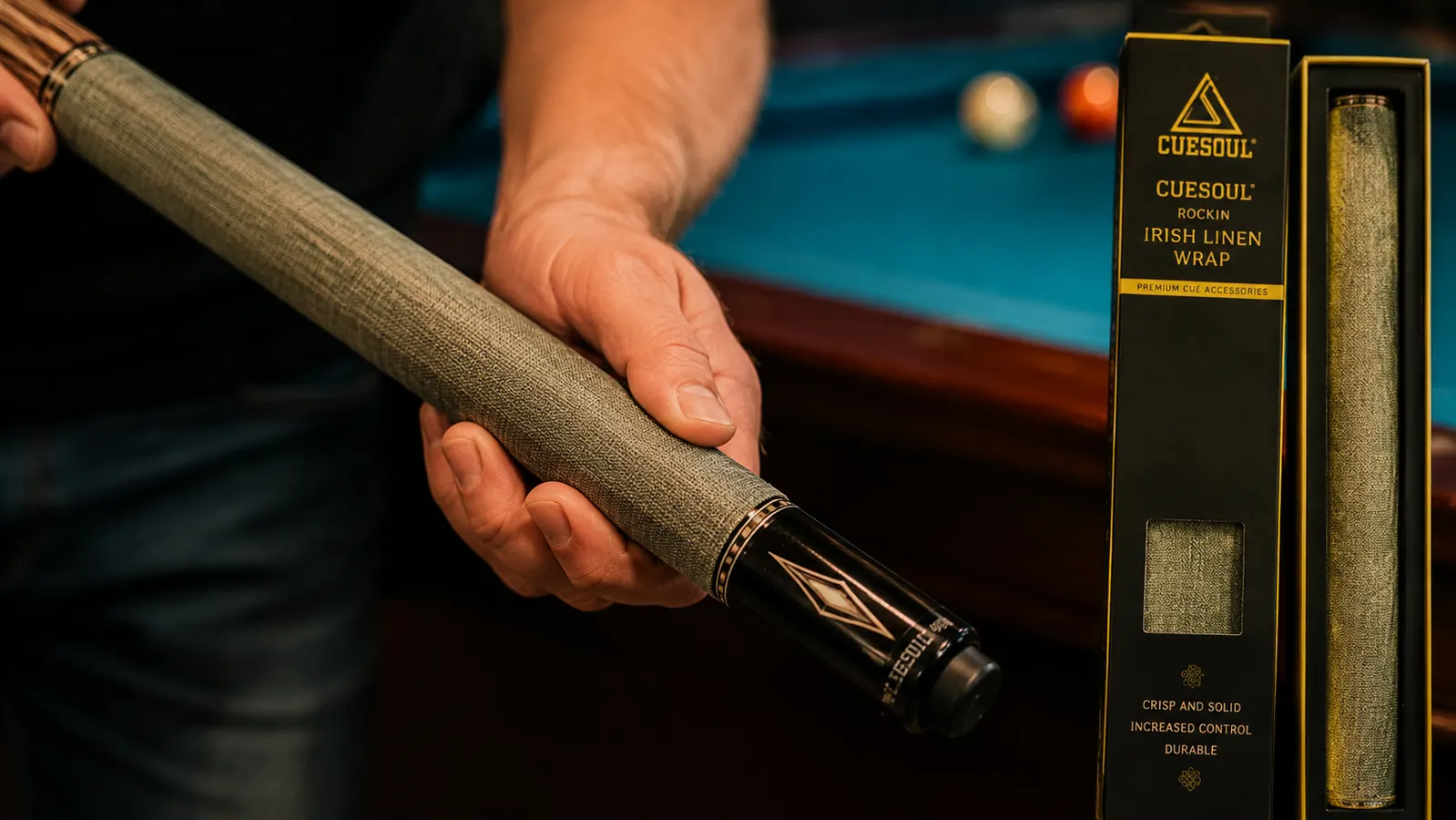
The Rockin Series uses Irish linen on the butt wrap. This is a genuinely good call at this price point. Most cues in the $40-$60 range use rubber or synthetic grip material, which degrades faster and gets slick in humid conditions. Irish linen is the standard on mid-grade cues from Lucasi, Viking, and McDermott, and the fact that CUESOUL includes it at this price is a legitimate advantage.
The one condition: Irish linen absorbs chalk dust. After a full league night in a bar where everyone at the table is chalking every shot, the wrap picks up a visible grey-blue tinge. It does not affect grip or performance, but it looks dirty quickly. A quick wipe with a dry cloth between sessions keeps it looking maintained. If you are the kind of player who wants gear that looks pristine without effort, the linen wrap will bother you. If you care about function over appearance, you will not give it a second thought.
I played through a July bar tournament in a building that had one window unit struggling against 90-degree heat. My palms were sweating through the grip by the third game. The linen held its texture throughout. I did not slip once on a stroke. That is the real test of a wrap, and the Rockin passed it. A rubber grip in the same conditions would have turned into a handlebar on a bicycle you forgot to dry after washing.
The stock tip arrives hard enough that your first draw shots will feel like you are shooting with a break cue. Scuff the tip before your first session. That one step changes the entire first-month experience.
What the Listing Does Not Tell You About the Kit
The Rockin Series is marketed as a kit, which means it comes with a cue case and a bridge stick in addition to the two-piece playing cue. The listing shows this clearly. What it does not tell you is that the included case is a nylon soft case with minimal padding. If you intend to transport your cue in a car trunk or on public transit, that soft case is not going to protect against a hard knock. The case is adequate for carrying from your car to the bar and back, which is probably its intended use, but do not confuse it with protection.
The bridge stick in the kit is a functional mechanical bridge, not a premium one. The bridge head is molded plastic and sits at a fixed angle. For most recreational players this is perfectly fine. If you are at a level where you are using the mechanical bridge for precision shots over clusters, you will probably want to buy a separate bridge head with adjustable height at some point. Again, this is not a criticism of the product so much as a calibration of expectations for what kit accessories at this price point actually are.
What the kit does deliver that has real value: the cue itself is protected from rattling against the bridge stick during transport by a separate interior sleeve. The case closes with a double zipper and a shoulder strap loop. For someone moving from carrying their cue in a house-stick rack to owning their first personal kit, the packaging function is solid. Just do not treat it like a Predator hard case.
The Taper: Why Your First Three Sessions Feel Off
The Rockin Series shaft uses what the billiards world calls a pro taper, sometimes called a Euro taper. The shaft diameter stays consistent, or nearly so, for approximately the first ten to twelve inches from the tip before widening toward the joint. Contrast that with a conical taper, which begins widening immediately from the tip. Most house cues, budget big-box cues, and entry-level Players sticks use a conical taper.
If you have been shooting on a conical taper for a year or more, the pro taper on the Rockin will feel unfamiliar at your bridge. Your bridge hand is calibrated to a shaft that gets wider faster, so the contact point between shaft and bridge fingers changes. This is not a defect. Pro tapers are common on higher-end cues from Predator, OB, and McDermott. The adjustment period is real but short. By your third or fourth session the muscle memory resets and you stop noticing it.
The issue is that some players buy the Rockin, play two sessions, feel like something is wrong with their stroke, and return the cue. That adjustment discomfort is not the cue's fault. If you feel that way in your first week, stick with it. The full picture of how the Rockin plays over time is detailed in the CUESOUL Rockin long-term use review, which covers how the shaft feel evolves after you have put real miles on it.

What I Liked
- Irish linen wrap handles sweat and humid bar conditions better than rubber or synthetic grips
- Joint threads stay tight through repeated break-down and assembly with no detectable wobble
- Pro taper shaft is consistent with higher-price-point cues, not a budget knock-off profile
- Kit includes case and bridge stick, which adds genuine starter value even if the accessories are basic
- 4.6-star average from 4,300-plus reviews signals reliable unit-to-unit consistency at the factory level
- Weight options at 18, 19, and 21 ounces let you match your preferred swing weight without guessing
Where It Falls Short
- Stock tip arrives hard and needs immediate scuffing or a short break-in period before it grabs correctly
- Shaft deflection is standard maple, not low-deflection, and will frustrate spin-heavy players expecting OB or Predator performance
- Pro taper feels wrong for the first two to three sessions if you are coming from a conical-taper cue
- Included soft case offers minimal impact protection for transport beyond car-to-bar use
- Irish linen picks up chalk dust quickly and needs regular wiping to look maintained
Who This Cue Is Actually For
The CUESOUL Rockin is the right cue for a player who has been playing on house sticks or a budget big-box cue and wants a real personal stick without spending $150 or more. It is also the right call for a new league player, someone in their first season of APA or BCA, who wants a reliable baseline cue to develop stroke mechanics on before they are ready to evaluate what a Viking or a McDermott actually offers. The construction is honest for the price. The joint holds. The wrap works. The shaft is consistent.
It is also a reasonable backup or practice cue for intermediate players who do not want to put daily wear on a more expensive stick. If your primary cue is a Lucasi Hybrid or a lower-end Viking and you want something you can leave in the car for drop-in sessions at a bar without worrying about it, the Rockin fits that role.
Who Should Skip It
Skip the Rockin if you already play at an APA 6 or BCA 7 and above. At that level your game has specific requirements around shaft feedback and spin control that this cue will not meet. You can learn to compensate for the deflection, and plenty of competitive players shoot on standard maple shafts for their entire career, but if your game is dialed in enough that you feel the difference between tip hardness levels and shaft stiffness, you are ready for a cue in the $120-$200 range where those variables are more precisely controlled. The Viking Valhalla 100 and the lower-end McDermott Lucky series are the natural next steps.
Also skip it if you play primarily masse, jump, or heavy spin-heavy 9-ball. Those disciplines demand tip control and shaft performance that a $50 maple cue is not engineered for. And skip it if you expect a cue to arrive game-ready with no adjustment. If you are not willing to spend five minutes scuffing the tip and giving yourself three sessions to adapt to a new taper, you will have a bad first week and blame the cue for something that was never really the cue's fault.
Know what you are getting, and you will not be disappointed. The Rockin Series delivers exactly what a first personal cue should.
CUESOUL Rockin Series, 58-inch two-piece maple construction, complete kit with case and bridge stick. 4.6 stars from more than 4,300 verified buyers. Check the current Amazon price before stock moves.
Amazon Check Today's Price on Amazon →