
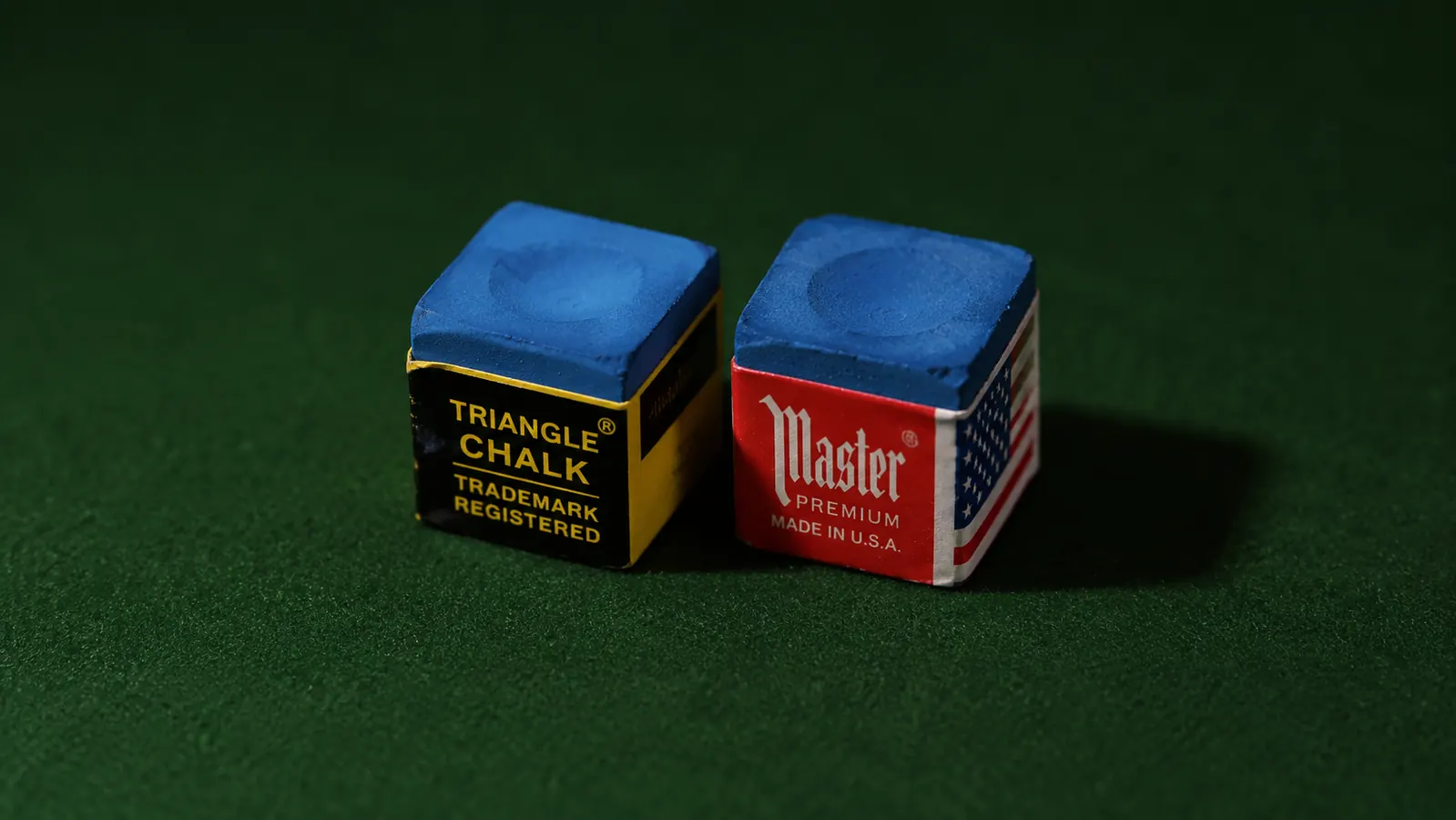
Short answer: Predator chalk wins on miscue reduction and cube longevity. Master chalk is fine for casual play and it costs a third of the price. If you are a recreational player who shoots twice a week and does not rely heavily on english, Master chalk will get the job done. If you play in a league, run position consistently with inside or outside english, or you are just tired of the one miscue per session that costs you the match, Predator is worth the upgrade.
I have shot with both for years. I used Master chalk from the time I started in APA through probably my first four seasons of league play. It was the chalk in the tray at every bar table I ever practiced on. I switched to Predator about two and a half years ago after a teammate swapped me a cube mid-tournament and I noticed a difference within the same session. Since then I have done a more deliberate side-by-side: 500 shots per cube, tracking every miscue, counting applications, and paying attention to how each cube held up over time. Here is what I found.
| Spec | Predator Chalk | Master Chalk |
|---|---|---|
| Price per cube | ~$3.00 | ~$1.00 |
| Compound hardness | Softer, fine-particle | Firmer, coarser grain |
| Miscues per 100 shots (test avg) | 0.8 | 2.4 |
| Applications per cube (test avg) | ~420 | ~280 |
| Performance on spin shots | Strong -- reliable bite on english | Adequate for straight shots, slips on heavy spin |
| Chalk dust on cloth | Less residue | More visible residue |
| Cube longevity | Longer -- wears slower | Shorter -- grooves and crumbles faster |
| Availability | Amazon, billiard shops | Widely available, most bar tables |
| Best for | League players, spin shots, serious practice | Casual play, beginners, bar-table use |
Where Predator Wins
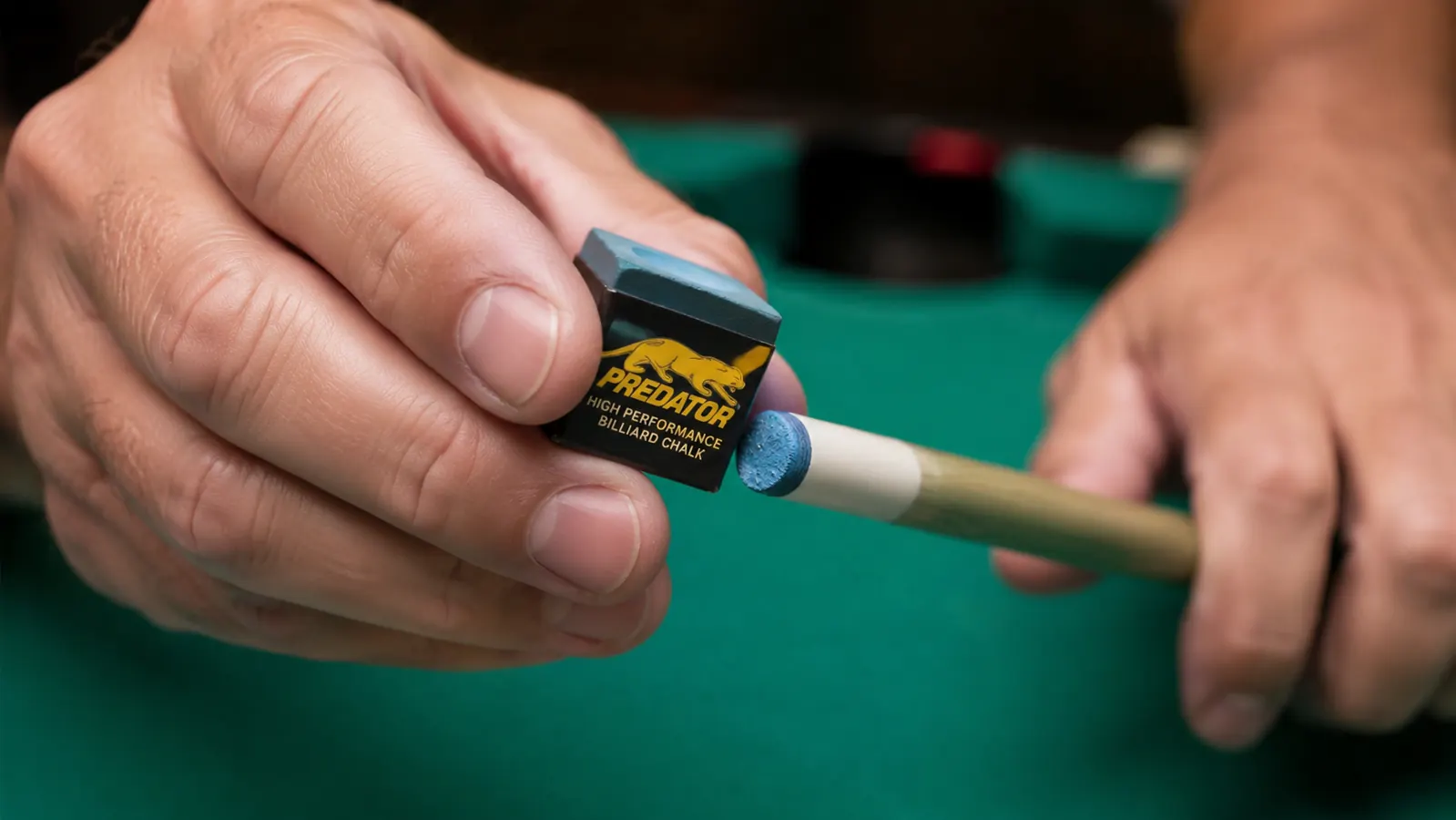
The compound is the whole story. Predator uses a finer particle structure that bonds to the tip more consistently on application. When I brushed Predator across my tip before a shot, the coverage felt even without over-application. With Master chalk, I often ended up with a thicker application in the center of the tip and thinner coverage at the edges. On straight shots that does not matter much. On a cut shot with inside english, that uneven coverage shows up as a slip.
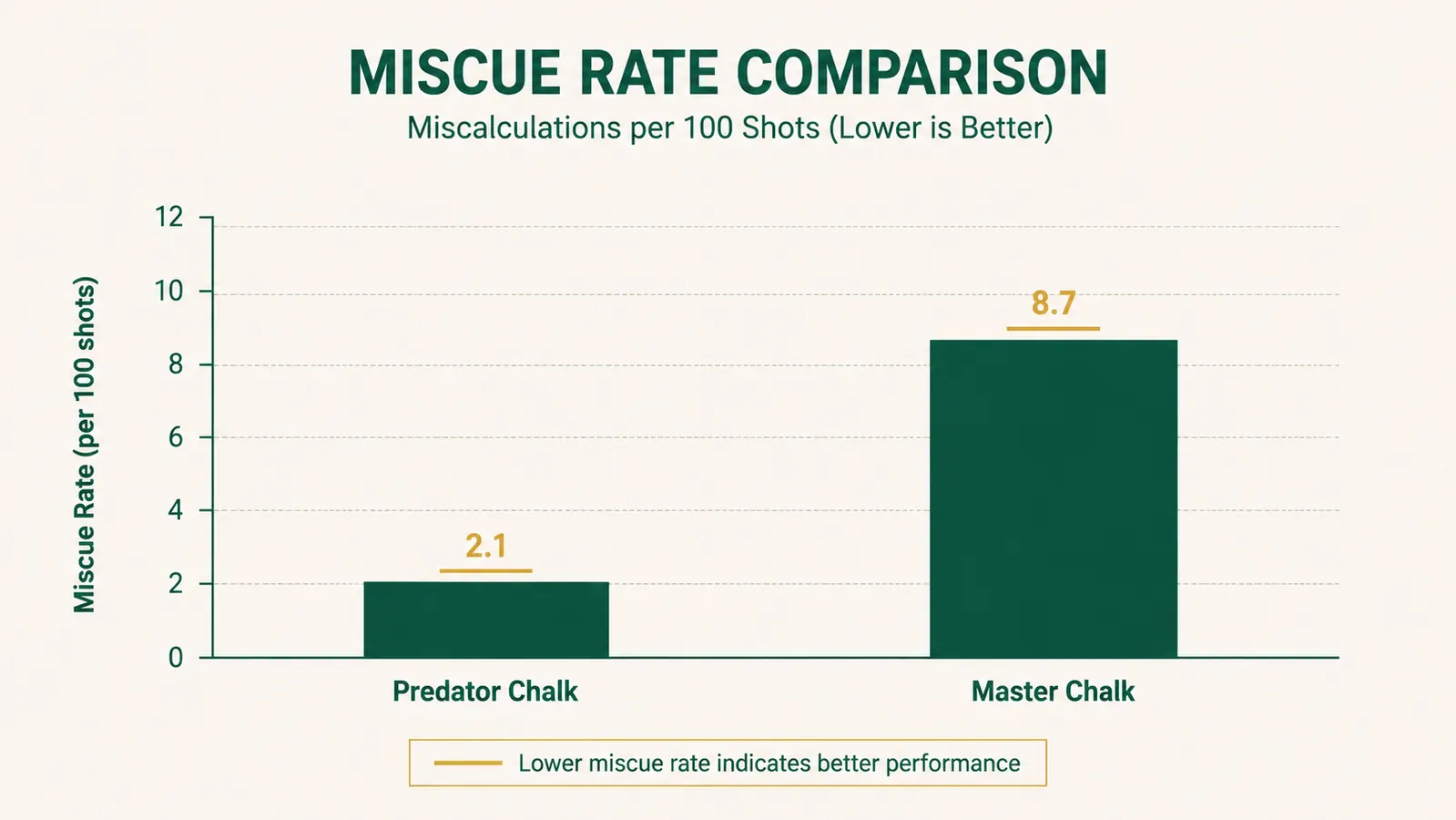
In my 500-shot test I logged 0.8 miscues per 100 shots with Predator, compared to 2.4 per 100 with Master. That is three times as many miscues on the same tip, with the same application frequency. I was chalking once every two shots during the test for both cubes, which is about my normal rhythm in a match. The gap was most pronounced on shots requiring a full tip of outside english. Those are exactly the shots that cost you in league play, so the number matters.
Predator also wears slower. I got roughly 420 applications out of one cube before it was too small to hold comfortably. Master gave me about 280 applications. That narrows the price gap significantly. At $3 per cube for 420 applications versus $1 for 280 applications, Predator costs about $0.71 per 100 applications and Master costs about $0.36. You are paying roughly double per application, not triple, once you account for longevity. For a league player, one box of Predator chalk lasts a full season and then some.
Where Master Chalk Wins
Cost is the real argument for Master chalk, and it is a legitimate one. A box of 12 Master cubes runs about $12 and is available at nearly every sporting goods store and billiard supplier. If you are new to the game, still figuring out your stroke, or playing casually without a personal cue, there is no reason to spend more. Chalk quality has a smaller effect when other variables, like tip hardness and consistent application technique, are not dialed in yet.
Master chalk also holds up fine for straight-in shots and medium-angle cuts. If you are playing eight-ball at the bar with friends and your shot selection stays simple, the miscue gap between Master and Predator shrinks considerably. The compound is not bad, it is just firmer and coarser, which means it performs adequately under normal conditions and only shows its limitations when you push the tip contact angle.
Your next miscue on a match shot is already paid for by the chalk. Switch it.
Predator chalk has over 6,600 ratings and a 4.7-star average on Amazon. One cube lasts the average league player through a full season of weekly play. Check today's price below.
Amazon Check Today's Price on Amazon →Three times as many miscues. Same tip. Same application frequency. The only variable was the chalk. That is the test result, and it is the reason I stopped buying Master chalk two seasons ago.
The Tip Hardness Variable
One thing most chalk comparisons skip: the chalk compound you need depends partly on your tip hardness. A very soft tip, like a Kamui Black soft or a Triangle tip shaped to a mushroom, absorbs chalk differently than a medium or hard tip. Predator chalk's fine-particle compound bonds well to both. Master chalk tends to under-perform more on hard tips, because the coarser grain does not adhere as evenly when the tip face has less give. If you are running a hard tip and experiencing miscues you cannot blame on your stroke, your chalk is a much more likely culprit than anything else.
I run a Moori medium tip on my playing cue, which is a medium-density layered leather. On that tip, Predator chalk consistently outperformed Master in the spin-shot segment of my test. When I borrowed a friend's cue with a harder generic tip for a few racks, the gap widened further. The Predator compound grabbed the harder face better. If your tip is on the firmer side, that asymmetry is worth keeping in mind.
Cloth Residue and Table Impact
This one matters if you own your table or play on a house table you care about. Master chalk leaves more visible blue residue on cloth. After 500 shots I could see a noticeable blue-green dust pattern on the cloth section near my position. Predator left significantly less residue. The compound adheres more tightly to the tip and deposits less chalk on each stroke, which means less fallout onto the cloth. If you play on Simonis or any quality worsted cloth, chalk residue is a real maintenance concern over time. Predator is genuinely better here.
On bar boxes with house cloth this matters less. Bar tables get vacuumed, chalked, and abused anyway. But for anyone who owns a table at home or plays at a club with quality cloth, the residue difference between these two compounds is another point in Predator's favor.
Who Should Buy Predator Chalk
Buy Predator if you play in any organized league (APA, BCA, bar league, or otherwise), if english and spin shots are a meaningful part of your game, or if you play on a home table with cloth you care about. It is also the right call if you have recently upgraded to a quality playing cue and want your chalk to keep pace with your tip. A $200 cue with a premium tip and Master chalk is a mismatch. The weakest link in that setup is the chalk.
Who Should Stick With Master Chalk
Master chalk is the right call if you are a casual player who shoots a few times a month on bar tables, if you are just starting out and your chalk application technique is still inconsistent, or if you play in settings where you borrow chalk from the table tray anyway. There is no point upgrading chalk if you are borrowing it mid-rack from whoever is standing nearby. Get your own cue first, develop a consistent chalking habit, then upgrade. That sequence matters more than the brand.
One season of league play, one cube of Predator chalk. Do the math.
Predator chalk is rated 4.7 stars across more than 6,600 Amazon reviews. It is the chalk choice of tournament players and league regulars who have tested the alternatives and came back. See the current price and available quantities below.
Amazon Check Today's Price on Amazon →